
Bitcoin Mining Difficulty: The New Challenges and Opportunities Ahead

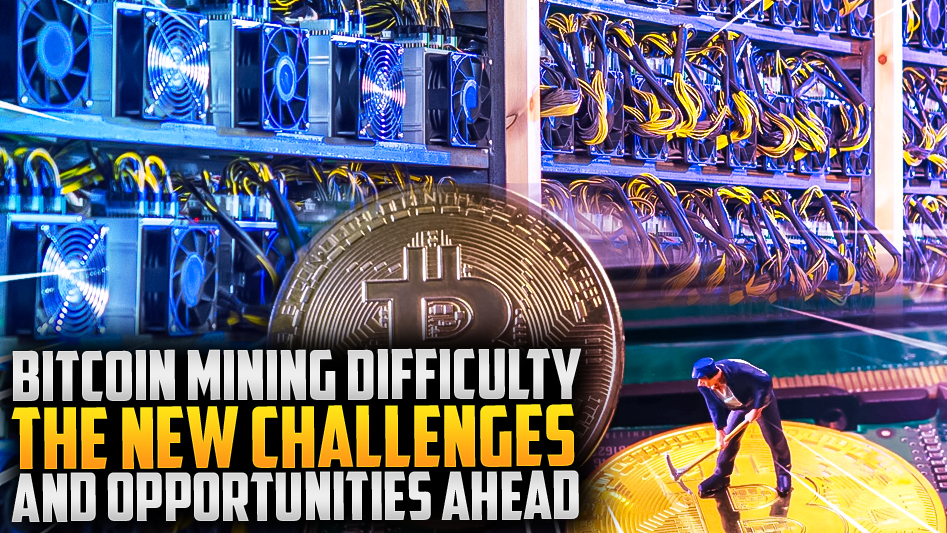
Table Of Content
In the ever-evolving world of cryptocurrencies, Bitcoin continues to dominate the market. As Bitcoin gains popularity and value, the process of mining it becomes increasingly challenging. This article delves into the new challenges and opportunities that lie ahead for Bitcoin mining difficulty.

Understanding Bitcoin Mining Difficulty
Bitcoin mining difficulty is a measure of how difficult it is to find a new block on the Bitcoin blockchain. It adjusts approximately every two weeks, based on the total computational power of the network. The higher the mining difficulty, the more computational power required to solve the complex mathematical problems and earn the Bitcoin reward.
The Impact of Increasing Difficulty on Miners
With the exponential growth of the Bitcoin network, the mining difficulty has soared to new heights. Miners face several challenges due to the increasing difficulty:
The Evolution of Mining Technology
In response to the challenges posed by increasing mining difficulty, miners and technology innovators are continually pushing the boundaries of mining technology. Here are some notable advancements:
1. ASIC Miners
Application-Specific Integrated Circuit (ASIC) miners have revolutionized the efficiency and speed of Bitcoin mining. These specialized machines are designed solely for mining Bitcoin, providing significant computational power while minimizing energy consumption.
2. Cloud Mining
Cloud mining has gained popularity as a cost-effective alternative to traditional mining setups. By renting mining power from remote data centers, miners can overcome the challenges of high electricity costs and hardware investments.
3. Mining Pools
Mining pools enable individual miners to combine their computational power and share block rewards. By working together, miners increase their chances of successfully mining blocks and earning rewards, even in the face of rising difficulty.

Strategies to Overcome Challenges and Seize Opportunities
Amidst the new challenges brought by increasing mining difficulty, there are also opportunities for miners to thrive. Here are some strategies to navigate the evolving landscape:
1. Optimize Energy Efficiency
Energy consumption is a significant cost factor in Bitcoin mining. Miners can explore energy-efficient mining practices, such as using renewable energy sources or optimizing hardware configurations, to reduce expenses and increase profitability.
2. Diversify Mining Portfolio
Instead of solely relying on Bitcoin mining, miners can explore other cryptocurrencies that offer lower mining difficulty or higher potential returns. Diversifying the mining portfolio mitigates risks and increases the chances of profitability.
3. Stay Informed and Adapt
The cryptocurrency industry is highly dynamic, with new technologies and trends emerging regularly. Miners must stay informed about the latest developments, adapt their strategies accordingly, and embrace innovation to remain competitive.
4. Explore Mining Alternatives
While Bitcoin mining difficulty continues to rise, alternative mining methods like Proof-of-Stake (PoS) and mining other cryptocurrencies can provide opportunities for miners to earn rewards without the energy-intensive process of Bitcoin mining.

Conclusion
Bitcoin mining difficulty presents both challenges and opportunities for miners. While rising costs, increased competition, and reduced block rewards pose hurdles, innovative technologies and strategic approaches can help miners adapt and thrive. By optimizing energy efficiency, diversifying mining portfolios, staying informed, and exploring alternatives, miners can overcome the new challenges and seize the opportunities that lie ahead.
FAQ
What is the purpose of adjusting Bitcoin mining difficulty?
The adjustment of Bitcoin mining difficulty ensures that new blocks are added to the blockchain approximately every 10 minutes, maintaining a steady flow of transactions.
How is Bitcoin mining difficulty calculated?
Bitcoin mining difficulty is calculated based on the total computational power of the network. It adjusts using a mathematical formula to maintain the desired block time.
Can increasing mining difficulty lead to centralization?
Yes, as mining difficulty increases, smaller miners may struggle to compete with larger mining operations, potentially leading to centralization of mining power.
Is Bitcoin mining still profitable despite the increasing difficulty?
Profitability in Bitcoin mining depends on various factors, including the cost of electricity, mining hardware efficiency, and market conditions. While challenges exist, profitable mining is still achievable with the right strategies.