⚡User Unwittingly Pays $3.1M for 139 BTC Transfer🔱

☕️ GM Dear Plebs!
Here is Crox Road, your daily dose of orange pill that will turn you into a Bitcoin Maxi.
The menu for today:
💄 Costly Mistake
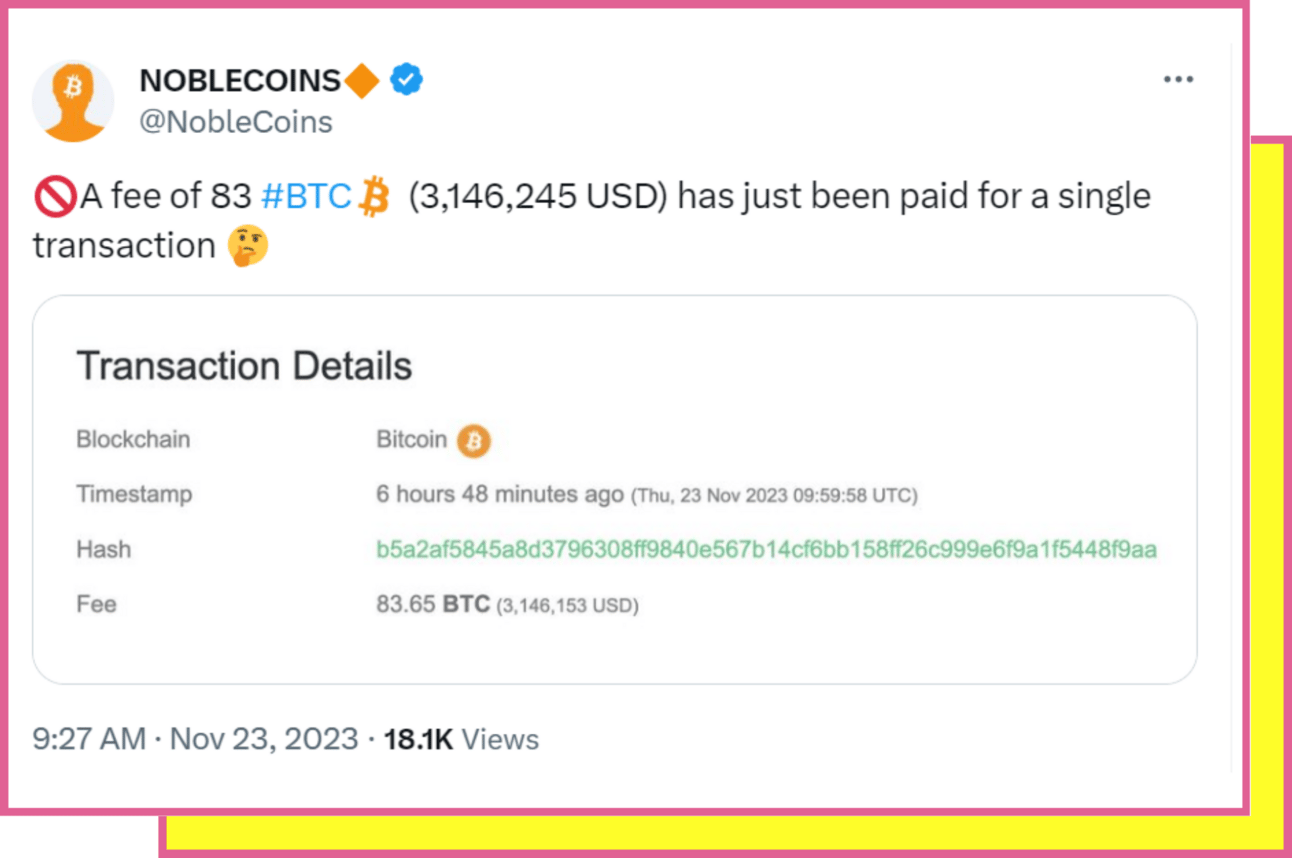
So, there's this Bitcoin user who tried to transfer 139.42 BTC, right? But here's the kicker – they accidentally paid a whopping $3.1 million in transaction fees! Imagine that, more than half the value of what they were actually sending.
This crazy mix-up went down on November 23 when the user, with the wallet address bc1qn3d…wekrnl, attempted to send the BTC to another address, bc1qyf…km36t4. But instead of the intended amount, the destination got only 55.77 BTC. Ouch!
Now, get this – the $3.1 million fee is the eighth-highest in Bitcoin's 14-year history. The mining pool Antpool was the lucky recipient of this insane fee on block 818087.
Social media is buzzing with theories. Some think the sender might have intentionally chosen a high fee, but there's more to it. There's something called replace-by-fee (RBF), allowing users to replace an unconfirmed transaction with a higher fee to get it processed faster. The user might not have known that you can't cancel RBF orders, leading to repeated attempts to replace the fee.
This isn't the first time someone messed up a Bitcoin transaction. Remember Paxos in September? They accidentally paid a $500,000 fee for a $2,000 transfer. At least in that case, the miner returned the accidental fee.
But wait, there's more drama. This $3.1 million fee beats the Paxos incident, making it the largest-ever in dollar terms. The largest fee in Bitcoin terms happened in 2016 when someone sent 291 BTC in fees!
Now, the plot thickens. A mempool developer, mononaut, thinks Antpool might not return the funds. Why? Well, it depends on their payout policies and how they handle transaction fees with their miners.
Antpool is keeping mum about the whole thing. No comments yet. It's a wild ride in the world of Bitcoin!

🪖 Binance vs. Coinbase
Hey, did you hear about the Bitcoin shuffle from Binance to Coinbase? According to some data called CryptoQuant, in just one day, Coinbase's Bitcoin stash got a boost of around 12,000 BTC, while Binance took a hit, losing 5,000 BTC.
Now, why the sudden move? Bradley Park, a smart dude at CryptoQuant, says it's probably regular folks pulling their Bitcoin out of Binance, maybe because they're a bit jittery after all that legal drama Binance got tangled up in recently. Greta Yuan from VDX in Hong Kong thinks people are just playing it safe, shifting their funds to exchanges that are more compliant and licensed.
And guess what, Coinbase seems to be the chosen one in this scenario. Greta, in her note to CoinDesk, gave Coinbase a thumbs up, saying it's stood the test of time. That's some confidence right there!
Oh, and there's this interesting theory floating around. Some analysts are saying that Binance settling with the U.S. Department of Justice is like the final lap before they get the green light for a spot Bitcoin ETF. So, maybe all this movement is because people are thinking, 'Hey, let's get on the ETF train before it leaves the station.'
CryptoQuant even spotted a 1,000 BTC withdrawal from Coinbase. Bradley Park thinks it might be some big shot doing an over-the-counter (OTC) trade, basically a fancy way of saying a big institutional deal. And get this – it could be a bet on the ETF getting the thumbs up.
Here's the thing, though. Even though everyone is cheering for the Bitcoin reserves on exchanges going down (which is apparently a good sign in the crypto world), some folks are still wary. Ever since FTX took a nosedive last year, trust in these big exchanges has taken a hit. People are stashing their digital cash in other places, just to be safe.

✖️ Mayer Multiple
The Mayer Multiple is a cryptocurrency metric named after Trace Mayer, and it is used to assess the current valuation of Bitcoin relative to its historical price trends. The calculation involves dividing the current price of Bitcoin by its 200-day moving average. This ratio is thought to provide insights into whether Bitcoin is currently overvalued or undervalued based on its long-term average price. A Mayer Multiple above 1 indicates that Bitcoin's price is higher than its historical average, suggesting a potential overvaluation, while a multiple below 1 suggests undervaluation. The Mayer Multiple is often used as a simple yet effective tool for investors and analysts to gauge the broader market sentiment and make informed decisions about Bitcoin's valuation in the context of its historical performance.

🤣 Crox Road Memes


“If you want to make enemies, try to Buy Bitcoin.”