
Trump’s Support Couldn’t Save Bitcoin – Here’s Why It’s Falling Again

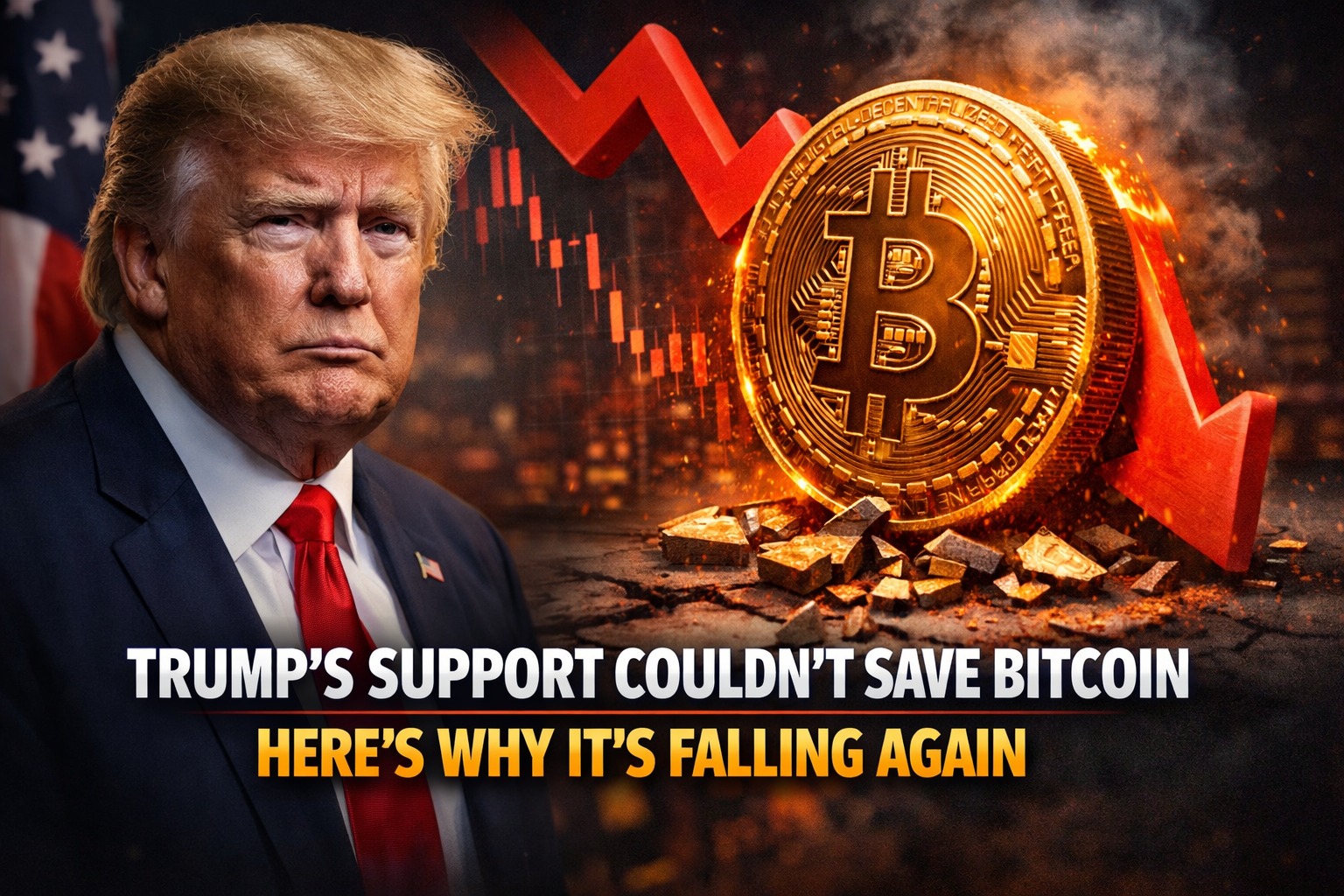
Bitcoin has never been a purely political asset, yet political narratives often influence short term sentiment. Recent optimism surrounding Donald Trump’s pro crypto rhetoric created expectations of a sustained rally. Instead, Bitcoin reversed and slid again, leaving many investors asking a simple question:
The answer lies not in a single catalyst, but in the interaction between macroeconomics, liquidity conditions, derivatives positioning, and market psychology.
Table of Contents

1. Markets Price Expectations, Not Headlines
Financial markets are forward looking mechanisms. By the time political support becomes widely discussed, it is typically already reflected in price.
When traders anticipated a crypto friendly stance:
Once that optimism peaked, the marginal buyer disappeared. Without fresh capital, prices stalled and became vulnerable to reversal.
Key concept:
Bullish narratives move markets only while they are still being repriced.
2. Liquidity Still Dominates Bitcoin’s Direction
Bitcoin behaves like a global liquidity barometer. Regardless of political positioning, liquidity conditions remain the primary driver.
If liquidity tightens:
Factors affecting liquidity include:
Even a crypto supportive administration cannot override restrictive monetary dynamics in the short run.
3. Higher Rates Continue to Pressure Risk Assets
Elevated interest rates reshape investor behavior:
Bitcoin, while structurally scarce, is still treated as a high volatility asset. When real yields rise, capital often rotates away from non yielding instruments.
Result:
Price corrections occur despite long term bullish fundamentals.

4. Derivatives and Leverage Amplify Downside
Bitcoin’s spot moves are frequently exaggerated by derivatives markets.
During euphoric phases:
When price weakens:
This mechanical deleveraging can produce sharp drops that appear disconnected from news flow.
5. Narrative Fatigue and Sentiment Reset
Markets cycle between extremes:
Political support initially fueled optimism. But once the narrative lost novelty:
Bitcoin frequently undergoes these resets even within broader bull markets.
6. Global Factors Matter More Than Domestic Politics
Bitcoin trades 24/7 across jurisdictions. Its price reflects:
While US politics influences perception, Bitcoin’s valuation remains a function of international liquidity and adoption trends.
7. Corrections Are Structural, Not Exceptional
Bitcoin’s historical pattern includes repeated drawdowns:
These movements are characteristic of an emerging monetary asset transitioning toward maturity.
Short term declines do not necessarily invalidate long term trajectories.
Trump’s crypto friendly stance may shape future regulatory frameworks and institutional participation. However:
✅ Political support affects structure
❌ Liquidity affects price
Bitcoin’s decline is better explained by:

Conclusion
Bitcoin’s renewed decline underscores a fundamental market principle: price direction is driven primarily by liquidity conditions rather than political narratives. While supportive rhetoric can shape expectations and temporarily boost sentiment, it cannot offset the effects of tight monetary policy, elevated real yields, and risk asset deleveraging. Once optimism becomes fully priced in, the absence of fresh capital often leaves the market vulnerable to profit taking and volatility spikes.
Importantly, such pullbacks are not abnormal within Bitcoin’s historical structure. Cycles of rapid expansion followed by sharp corrections and consolidation phases have repeatedly occurred throughout its evolution. Political developments may influence the long term regulatory and institutional landscape, but short term price behavior remains anchored to macroeconomic forces, capital flows, and derivatives positioning. Volatility, therefore, is not a deviation from Bitcoin’s nature but an inherent characteristic of an emerging global asset.
FAQs
Did Trump’s support have any impact on Bitcoin?
Yes. Political rhetoric can influence short term sentiment and speculative positioning, especially when tied to expectations of regulatory clarity.
Why does Bitcoin still react to macroeconomics?
Because Bitcoin competes for global investment capital. Interest rates, dollar strength, and liquidity determine how much risk investors are willing to take.
Is Bitcoin’s drop unusual?
No. Corrections are historically normal and often occur even during long term bull cycles.
Can political change drive a future rally?
It can contribute, particularly if accompanied by structural shifts such as favorable regulation, ETF flows, or institutional adoption. However, liquidity remains decisive.