⚡False ETF News Shakes Bitcoin📰

☕️ GM Dear Plebs!
Here is Crox Road, your daily dose of orange pill that will turn you into a Bitcoin Maxi.
The menu for today:
🚀 False Report Pushes Price to $30,000
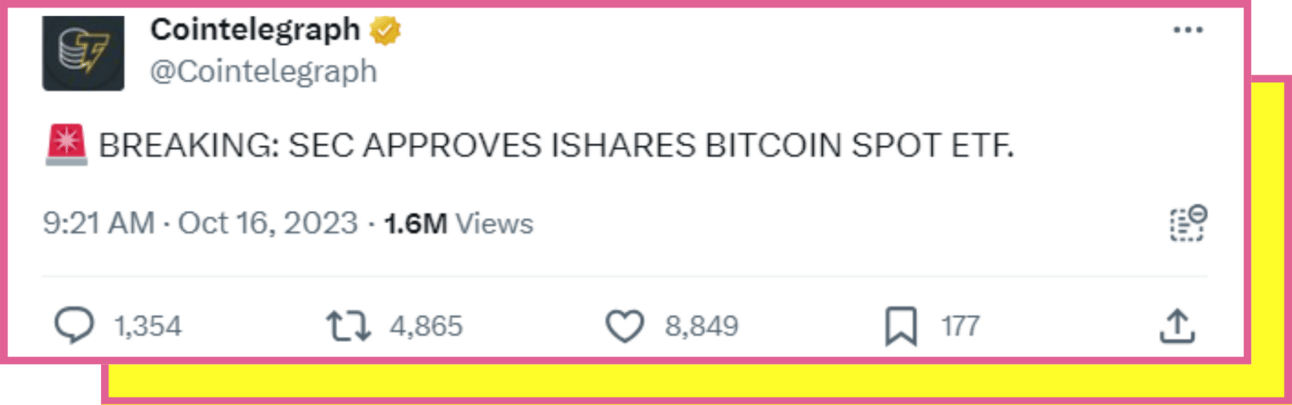
So, there was this crazy moment when a totally fake story about the US approving a Bitcoin ETF got everyone super excited. The rumor was spread through Cointelegraph's X account on social media, and it caused the price of Bitcoin to shoot up by a whopping $2,000 in just a short period. This sudden spike in Bitcoin's price caused a lot of chaos in the cryptocurrency world, leading to a crazy rollercoaster of ups and downs, and it even forced people to sell off their Bitcoin holdings, resulting in over $100 million in hourly losses. But, in the end, it turned out to be nothing but a big misunderstanding. Bitcoin's price went up, and then it came right back down when people realized it was all just a rumor.
So, the whole confusion started with a tweet that was later edited and eventually deleted around 10 am Eastern Time. It suggested that the SEC had approved BlackRock's spot Bitcoin ETF application, but that wasn't the case. A spokesperson from BlackRock confirmed that their application was still under review by the SEC. Furthermore, sources close to the SEC made it clear that the report from Cointelegraph was completely false. Back in late September, the SEC had already postponed its decision on BlackRock's ETF application and others, pushing the decision deadline into January of the following year. According to Bloomberg analysts James Seyffart and Eric Balchunas, they think there's a 75% chance of a spot Bitcoin ETF approval by the end of 2023, but they also emphasized that the Monday morning post on X couldn't be verified with any evidence.
Right after that post went out, Bitcoin went on a crazy ride. On the Binance
BTC/USDT market, which is a pretty big deal, Bitcoin's price shot up from $27,883 to a whopping $30,000 in just about half an hour – that's a 7% jump! This kind of wild price action was especially intense for folks trading in Bitcoin derivatives. According to data from Coinglass, in just one hour, around $105 million worth of trading positions got wiped out, with $73 million from people betting that Bitcoin's price would go down (shorts) and $32 million from those thinking it would go up (longs). And if that wasn't enough, in the past day, about 40,000 traders got liquidated, losing nearly $180 million.

🍩 SEC Misses Deadline on Grayscale Bitcoin ETF
U.S. Securities and Exchange Commission (SEC) has missed its deadline to challenge a court decision in favor of Grayscale's Bitcoin exchange-traded fund (ETF). This doesn't necessarily mean that they're giving the green light for the ETF just yet. They're basically saying, "We're not going to fight this decision in court." According to a source cited by Reuters on October 13th, the SEC has chosen not to appeal the court's ruling. It's a situation that's leaving people in the cryptocurrency world wondering what's next. The SEC's decision not to appeal doesn't automatically mean they'll approve the Bitcoin ETF, but it does leave the door open for further developments in this space.
This legal showdown between the U.S. financial watchdog (SEC) and the asset management company Grayscale started back in the previous year. Grayscale wanted to turn its flagship product, the Grayscale Bitcoin Trust (GBTC), into a spot Bitcoin ETF. Basically, they wanted to make it easier for people to invest in Bitcoin through this exchange-traded fund. If the SEC had given the green light, it would have allowed Grayscale to create a Bitcoin-backed asset that tracks Bitcoin's price more accurately than GBTC. But the SEC said no last year, and Grayscale wasn't too thrilled about it. They actually sued the SEC over this decision, and after a year of legal battles, Grayscale scored a significant victory in August. A federal court, with a panel of three judges, told the SEC to reconsider approving Grayscale's request for a spot Bitcoin ETF and called the SEC's previous delay "capricious." Now, the SEC had 45 days to ask for an en banc court hearing, which involves all the court judges deciding together, rather than just one or a small panel of judges.
While the SEC's choice not to contest the court ruling from August regarding Grayscale's Bitcoin ETF might seem like a positive development, it doesn't guarantee immediate approval for the spot Bitcoin ETF in the United States. Jennifer Schulp, the director of financial regulation studies at the Cato Institute's Center for Monetary and Financial Alternatives, emphasized that this doesn't mean approval is imminent, and it's far from a sure thing. The SEC still has the option to re-review the application and potentially deny it on different grounds, essentially restarting the legal battle. So, while it's a step forward, the path to a spot Bitcoin ETF's approval remains uncertain and subject to further scrutiny by the SEC.

🔝 Non-Failure Swing
Non-failure swing chart patterns share similarities with failure swing charts, but they have a key distinction – in non-failure swings, the second peak remains above the first one, indicating an upward continuation in the price trend. These patterns often signal strong and persistent price movements. To make well-informed trading decisions, it's essential to consider both types of patterns in conjunction with other market indicators to confirm their accuracy and gain a more comprehensive understanding of the market's potential direction.

🤣 Crox Road Memes


“Bitcoin is the best meditation.”