
Bitcoin vs. Tether: The Silent War for the Soul of Crypto

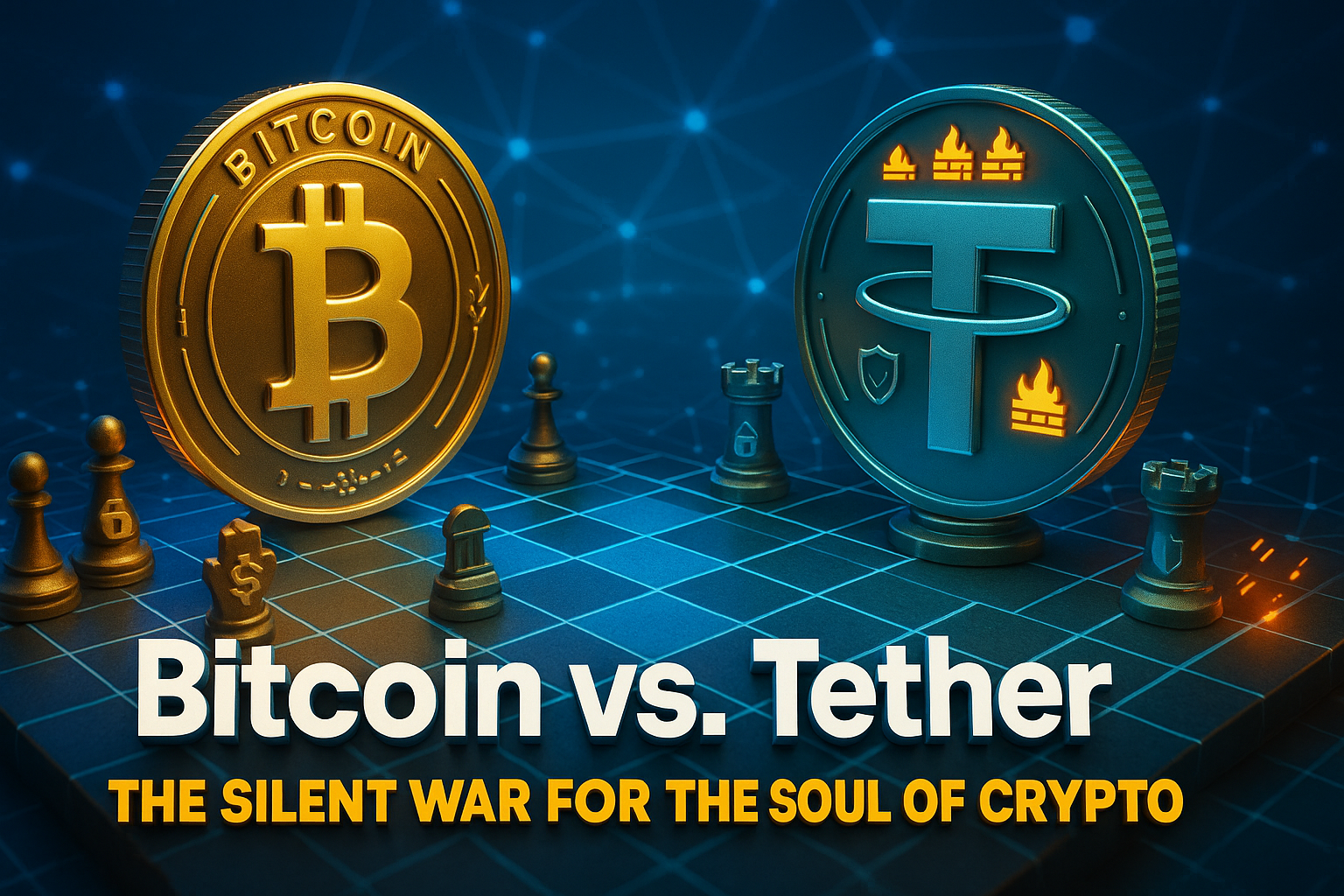
Bitcoin was born from rebellion — a digital revolution against the centralized control of money. It promised financial freedom, transparency, and autonomy. But fifteen years after Satoshi’s white paper, a new power has risen from within the crypto ecosystem itself: Tether (USDT), the world’s most widely used stablecoin.
While Bitcoin fights to separate money from the state, Tether has quietly become the crypto world’s central bank — printing billions in digital dollars, buying U.S. Treasuries, and embedding itself deep into the infrastructure that Bitcoin helped create. The question is no longer whether Bitcoin can survive governments — it’s whether it can survive its own allies.
Table of Contents

1. Tether’s Rise: The New Central Bank of Crypto
Tether started as a simple promise: a dollar-backed token that made it easier to trade crypto without dealing with banks. But over time, it has evolved into something much more powerful. With over $120 billion in circulation, Tether now sits at the center of nearly every major exchange, payment rail, and decentralized finance platform.
Its reserves include tens of billions of dollars in U.S. Treasuries — making it one of the largest non-state holders of U.S. government debt. This means that every time traders mint USDT, they indirectly help finance the same fiat system Bitcoin was designed to escape.
In essence, Tether turned the blockchain into a platform that serves the dollar, not replaces it.
2. The Paradox of Freedom: Bitcoin’s Rails, Fiat’s Rules
Bitcoin’s network and philosophy stand on decentralization — no intermediaries, no permissions, no censorship. Yet stablecoins like Tether now flow across Bitcoin-adjacent networks such as Liquid and RGB.
This fusion brings liquidity and adoption, but it also imports the rules of the old system:
By embedding Tether too deeply into Bitcoin’s ecosystem, there’s a risk that the very rails meant to liberate humanity from fiat become tools for digital compliance. Bitcoin’s sovereignty could be diluted under the weight of dollar-backed convenience.
3. The Fiat Loop: How Tether Reinforces the System
Every USDT in circulation represents a dollar that’s not in your pocket — but in the custody of a private company holding U.S. Treasuries. That creates a feedback loop:
Ironically, while Tether’s reserves support the U.S. financial system, its profits are being used to buy Bitcoin — turning the symbol of fiat debt into fuel for the revolution. It’s a paradox that both strengthens and endangers Bitcoin’s future.

4. The Ethics of Power: Who Controls the Revolution?
At its core, the conflict isn’t about technology — it’s about ideology.
If a handful of executives can freeze billions with a click, what separates them from the bankers Bitcoin was built to defy?
This is the silent war — not fought in headlines, but in code, custody, and ideology. Bitcoiners must ask: Is adoption worth losing the soul of decentralization?
5. The Road Ahead: Decoupling or Integration?
The future of crypto may depend on how these two forces evolve:
The choice isn’t technical — it’s moral.
Will Bitcoin remain the tool of freedom it was meant to be, or will it become just another layer of a digital dollar empire?

Conclusion
The real threat to Bitcoin may not come from the state — but from within the system it helped inspire.
Tether’s dominance shows how power always finds a way to centralize, even in a decentralized world. If Bitcoin’s revolution is to endure, its community must guard not just its price — but its principles. Because in the end, this isn’t just Bitcoin vs. Tether.
It’s Freedom vs. Control.
It’s the silent war for the soul of crypto.
FAQs
Why is Tether controversial?
Tether faces criticism for its opaque reserves, regulatory ambiguity, and potential overreliance on U.S. Treasuries. Critics argue it holds systemic power without accountability.
Does Tether’s growth harm Bitcoin?
It’s a double-edged sword. Tether’s liquidity benefits Bitcoin’s market, but its centralization risks undermining Bitcoin’s decentralization ethos.
Can Bitcoin exist without Tether?
Yes, but liquidity and trading volume would temporarily suffer. In the long run, Bitcoin-native stable systems could fill that role.
Is Tether buying Bitcoin a good thing?
It’s complex — while it strengthens Bitcoin’s scarcity narrative, it also deepens fiat entanglement and raises questions about motive and control.
What can users do to protect Bitcoin’s ethos?
Self-custody, peer-to-peer transactions, and support for decentralized alternatives that don’t rely on centralized stablecoins.