
⚡Astrophysicist Claims $1M Bitcoin Price by 2033🧑🚀

☕️ GM Dear Plebs!
Here is Crox Road, your daily dose of orange pill that will turn you into a Bitcoin Maxi.
The menu for today:
🌌 Bitcoin's Meteoric Ascent
There's this new way of predicting Bitcoin's price, and it's gaining attention. This model, called the "Bitcoin Power Law," is not your typical crystal ball stuff – it claims to be backed by maths and science.
Here's the deal: Imagine a chart that shows Bitcoin's price over time, but it's not your regular chart. It's on a log-log scale, meaning the prices and time are scaling up exponentially. The result? A line that goes up and to the right, kind of like a staircase, capturing Bitcoin's highs and lows with what some people are calling "amazing" accuracy.
The brain behind this is Giovanni Santostasi, a former physics professor, who cooked up this model back in 2019. He explains that the idea is based on a "Power Law," which is a fancy way of saying a relationship between two things where one is proportional to a fixed power of the other. Think of it like a rule that holds true no matter how big or small the quantities are, creating a straight line.
Santostasi likens this to nature's straight-line relationships, citing Kepler's laws of planetary motion as an example. Now, he's applying this concept to Bitcoin, saying it has a "power law behaviour" with a consistent pattern over time.
So, the maths bit looks like this: Estimated Price = A * (days from GB)^n, where GB is the Genesis Block of Bitcoin from 2009, A is 10^-17, and n is 5.8. When you crunch the numbers, the model suggests Bitcoin could hit $64,564 pretty soon.
Santostasi's crystal ball goes on to predict that Bitcoin will reach its "peak" at $210,000 in January 2026, then dip to $60,000 later that year. Short-term, he thinks it won't go lower than $35,000. By 2033, his model dreams big, saying Bitcoin could hit a cool $1 million.
Now, here's the reality check: Predicting Bitcoin's future is like predicting the weather; it's tricky. Some folks worry this model might give people unrealistic expectations, just like the stock-to-flow model that gained popularity last year.
Santostasi, however, prefers his city analogy. He sees Bitcoin not as an exponential rocket but more like a city growing steadily. He finds it fascinating, describing Bitcoin as a "shining city in cyberspace" that grows more like a reliable asset than a get-rich-quick scheme. Interesting, huh?

🏦 Banking Crisis Rattles Crypto Markets
The world is currently on edge because of some turbulence in the banking sector. Since 2023, banks have been facing losses, laying off staff, and dealing with cash shortages. This has got crypto investors worried about a potential drop in prices down the road.
Now, the US Federal Reserve is raising eyebrows. They've stopped calling the US banking sector "sound and resilient," a term they've been using since March 2023 to assure everyone that lending issues were under control.
The global banking scene isn't looking too hot either. A bank in New York announced some unexpected losses and started preparing for potential loan problems. Meanwhile, over in Germany, Deutsche Bank is laying off thousands to cut costs. Other big players like Citi and BlackRock are also trimming their staff.
This isn't the first shakeup in the financial world. Last year, Silicon Valley Bank faced a major crisis, and Silvergate bank even collapsed, sending shockwaves through the crypto markets.
Now, how does this affect crypto? Well, crypto markets usually dance to the tune of investor sentiments. If people are feeling jittery because of a banking crisis, it might not be good news for the crypto market. On the flip side, if there's a shift towards decentralised currencies, crypto markets could attract more investors.
As of now, Bitcoin prices are kind of in a holding pattern, swinging between $40,000 and $43,000. Analysts are comparing this phase to a drop in January 2021, but history shows us that periodic declines often precede a market recovery. Bitcoin is currently consolidating, influenced by selling related to ETFs, and with the next halving expected on April 7, 2024, there's a chance we might see a significant correction before a potential powerful rally. So, it's a bit of a wait-and-watch situation in the crypto world.

🤨 The Difference Between Proof-of-Work and Proof-of-Stake
Proof-of-Work operates like a competitive race among miners to solve intricate mathematical problems. In this model, the first miner to successfully solve the problem earns the right to add the next block of transactions to the blockchain. This process is resource-intensive, demanding powerful computational capabilities. Notably, PoW is often the preferred consensus mechanism for cryptocurrency networks that emphasise payment and monetary use cases. A prime example of PoW in action is Bitcoin, where miners engage in complex computations to secure the network and validate transactions.
Contrasting with PoW, Proof-of-Stake introduces a different method for selecting validators to add new blocks to the blockchain. In PoS, validators, or nodes, participate by locking up or delegating a portion of the network's tokens. The more tokens a participant commits or delegates, the higher the likelihood of being chosen to validate the next block of transactions. Unlike PoW, PoS is more energy-efficient as it doesn't involve computationally intensive problem-solving. However, one potential drawback is the requirement for participants to hold a significant amount of the cryptocurrency, making entry into the validation process potentially more expensive. PoS is commonly adopted by blockchains focusing on decentralised applications, such as Ethereum, Cardano, and Solana.
In summary, the fundamental distinction between PoW and PoS lies in the method of selecting validators and the associated difficulty requirements. While PoW involves miners competing through computational problem-solving, PoS relies on participants showcasing a stake in the network through token commitment or delegation. The choice between these consensus models often aligns with the overarching goals and applications of specific cryptocurrencies and blockchain networks.

🤣 Crox Road Memes

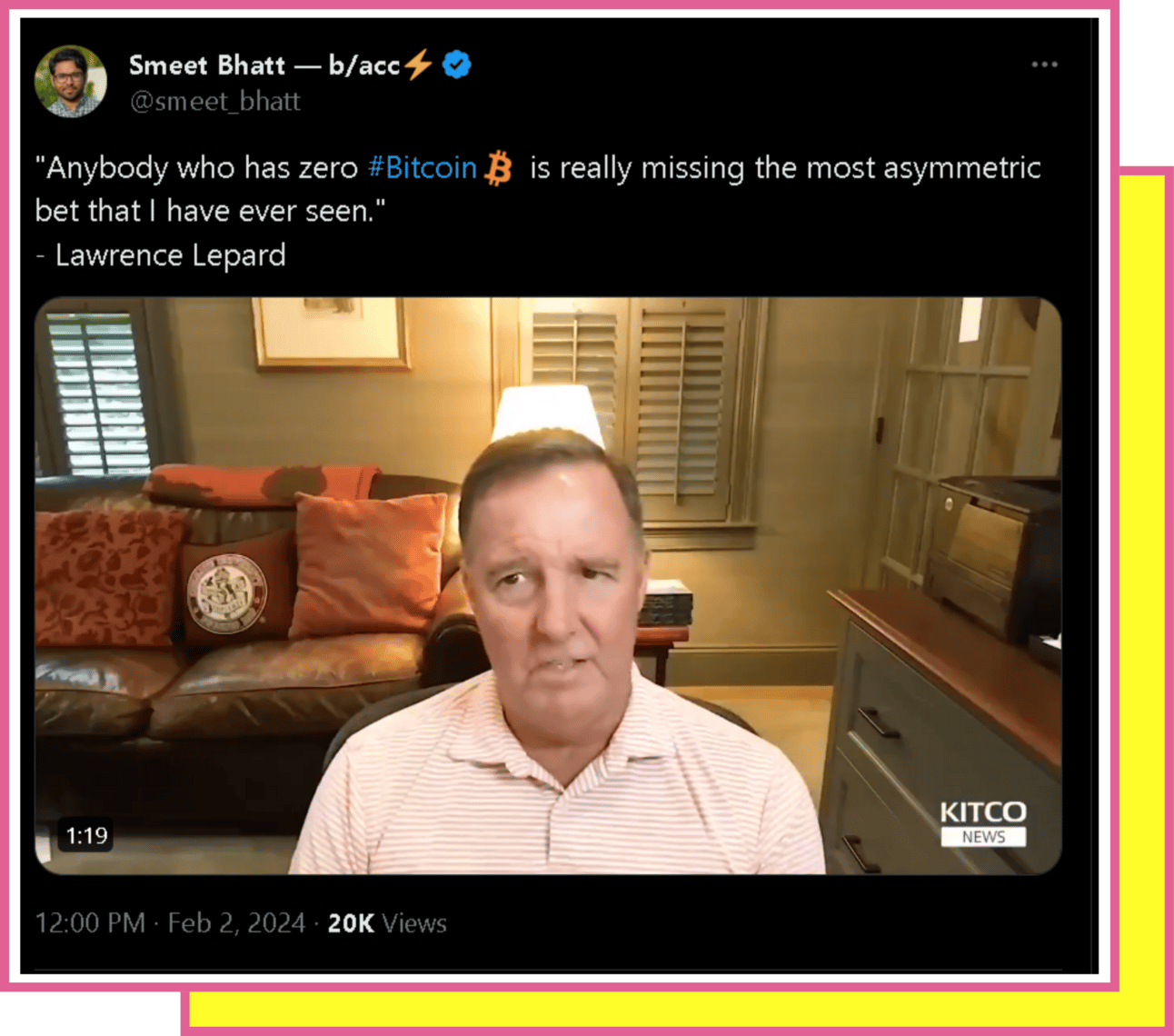

“In the future, there will be two types of companies: those that have been hacked and those that will be hacked, Bitcoin ain’t among them.”

Visit Our Store Here 👉🏻 https://croxroad.store/