
⚡$4.6 Billion Traded on Day One in the US Market⚕️

☕️ GM Dear Plebs!
Here is Crox Road, your daily dose of orange pill that will turn you into a Bitcoin Maxi.
The menu for today:
🇺🇲 Crypto Hype Hits Peak
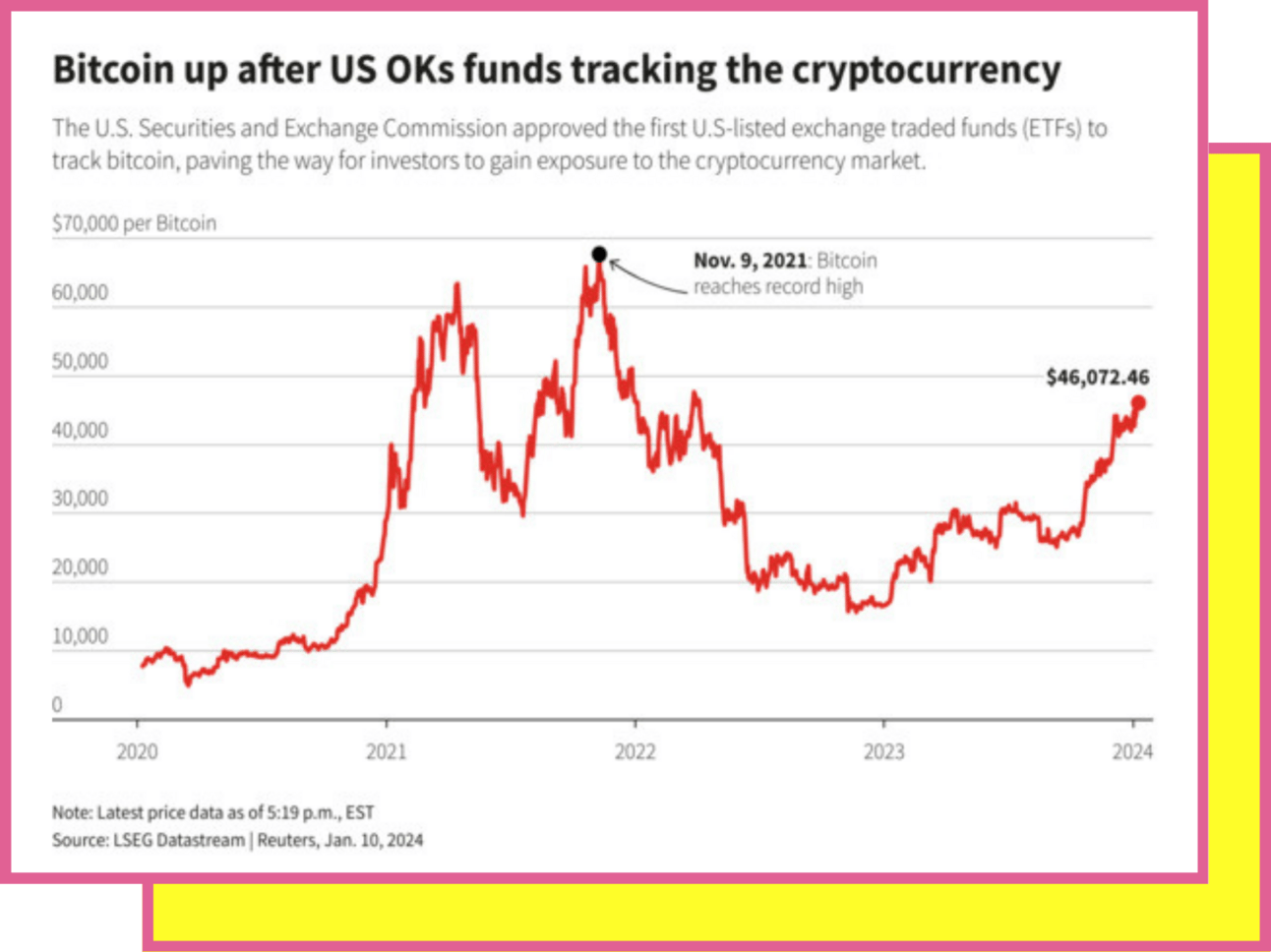
In a groundbreaking development, U.S.-listed Bitcoin exchange-traded funds (ETFs) witnessed a spectacular debut, amassing a staggering $4.6 billion in trading volume on their very first day, following approval from the U.S. securities regulator. Notable players in the crypto space, including Grayscale, BlackRock, and Fidelity, took centre stage, dominating trading volumes. The regulatory green light marked a significant milestone for the cryptocurrency industry, sparking intense competition among issuers and even prompting some to slash fees well below the industry standard prior to launch.
While the ETF launches propelled Bitcoin's price to its highest level since December 2021, there remains a mixed sentiment within the financial community. Executives caution about the inherent risks of Bitcoin, and regulatory authorities, such as the U.S. Securities and Exchange Commission (SEC), emphasised their approval is not an endorsement of the cryptocurrency, branding it a "speculative, volatile asset." Despite optimistic estimates projecting substantial flows into these ETFs, some analysts express caution, suggesting that broader acceptance of cryptocurrencies as a viable investment option may take time.
The market reaction to the Bitcoin ETFs extended beyond the digital asset itself, influencing cryptocurrency-related stocks. Initially climbing, these stocks experienced fluctuations, with Bitcoin miners and investors like Riot Platforms, Marathon Digital, Microstrategy, and Coinbase witnessing varying degrees of impact. Looking ahead, the approval of Bitcoin ETFs is seen by some as a potential catalyst for further innovation in the crypto space, possibly paving the way for additional products, including those related to Ethereum (Ether).
🤯 Cathie Wood's Visionary Call
Cathie Wood, the CEO of ARK Invest, shared an optimistic outlook on Bitcoin's future price during an interview on CNBC. Wood raised her previous prediction of Bitcoin reaching $1 million by 2030 to an even more bullish estimate of $1.5 million. She cited the recent approval of spot Bitcoin exchange-traded funds (ETFs) by the U.S. Securities and Exchange Commission (SEC) as a significant factor influencing her positive projection. Wood expressed confidence in a "bull case" scenario, emphasising that the likelihood of this optimistic outcome has increased with the SEC's approval, which she sees as a green light for further growth in the cryptocurrency market.
Wood also provided alternative scenarios, mentioning a "bear case" with a price of $258,500 and a "base case" of $682,800. ARK Invest justified its optimistic predictions by pointing to factors such as a higher hashrate, long-term holder supply, and addresses with a non-zero balance, comparing these metrics to previous market downturns. The SEC's approval of spot Bitcoin ETFs was highlighted as a reinforcing factor for ARK's positive outlook. It's worth noting that ARK Invest is one of the asset managers authorised by the SEC to introduce Bitcoin ETFs, which began trading on Thursday. Following the ETF approval, the price of Bitcoin briefly surpassed $49,000, reaching levels not seen since December 2021, though it later retraced to trade around $46,322. Other financial institutions, like Standard Chartered Bank, also anticipate significant growth in Bitcoin prices, drawing parallels to the historical performance of gold after the introduction of the first U.S.-based gold exchange-traded product.

🎫 Advantages and Disadvantages of Bond ETFs
Bond exchange-traded funds (ETFs) share similarities with individual bonds, offering regular coupon payments, typically disbursed every six months. The appeal of owning bonds lies in the reliable receipt of fixed payments at regular intervals. However, unlike individual bonds, bond ETFs hold assets with diverse maturity dates. Consequently, some bonds within the portfolio may be due for a coupon payment at any given time, resulting in monthly interest payments that vary.
Unlike traditional bonds that mature, assets within a bond ETF are continually changing, bought and sold as they expire or fall outside the fund's target age range. The challenge for the architects of these ETFs is to ensure effective tracking of their respective indices in a cost-efficient manner, particularly given the often illiquid nature of the bond market. Due to the infrequent trading of most bonds until maturity, establishing a robust secondary market is challenging, particularly for corporate bonds compared to government bonds.
To address liquidity concerns, suppliers of bond ETFs often employ representative sampling, meaning they track a sufficient number of the largest and most liquid bonds in an index. Government bond ETFs, benefiting from higher liquidity, tend to experience fewer tracking errors. While bond ETFs provide an avenue for exposure to the bond market, they come with limitations. Notably, an investor's initial investment is at greater risk compared to an individual bond since an ETF never matures, and there's no guarantee of full principal repayment. Additionally, when interest rates rise, the ETF's price may be adversely affected, similar to individual bonds, but the lack of maturity complicates the mitigation of interest rate risk.

🤣 Crox Road Memes



“I think, more than anything, Bitcoin presents an opportunity.”

Visit Our Store Here 👉🏻 https://croxroad.store/