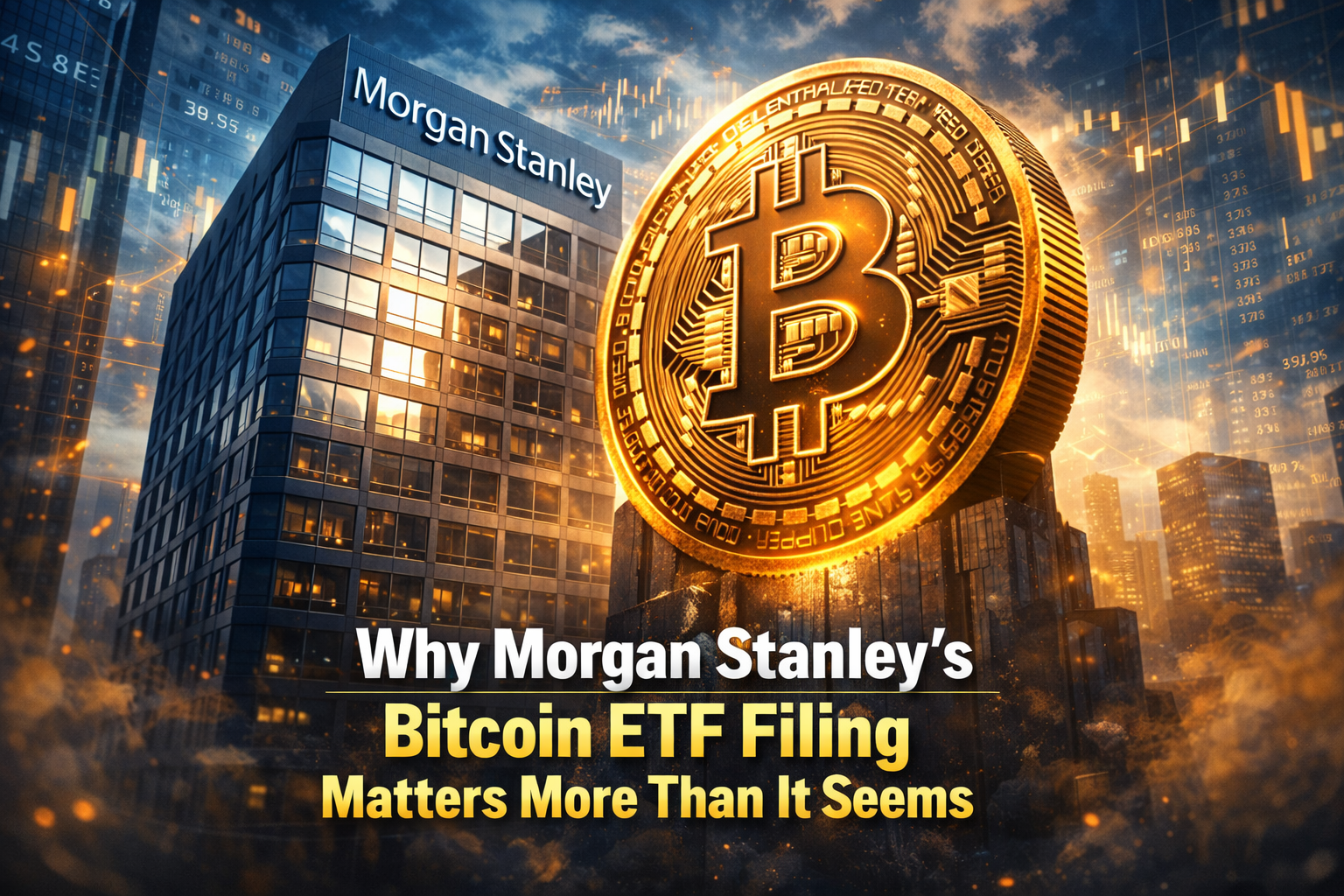
⚡200,000 BTC Exits Long-Term Holdings🪝

☕️ GM Dear Plebs!
Here is Crox Road, your daily dose of orange pill that will turn you into a Bitcoin Maxi.
The menu for today:
⌛ Bitcoin's Journey Beyond $52,000
Bitcoin recently reached $52,000, but it appears to have hit a barrier at this level, currently trading below this significant psychological threshold. Despite this, the overall sentiment remains optimistic.
Long-term holders of Bitcoin, often referred to as "hodlers," have collectively sold approximately 200,000 BTC since the beginning of the year. This selling trend has been consistent for nearly three months, leading to a decrease in their balances. However, this reduction is occurring at a much slower pace compared to the previous bull market, suggesting a more cautious approach by long-term holders in the current market conditions.
IntoTheBlock's analysis categorises this behaviour as "typical hodler activity" during bull runs, as it aligns with historical patterns observed among long-term holders.
Interestingly, the selling activity by long-term holders has been offset by substantial accumulation from various investor cohorts. According to CryptoQuant's CEO, Ki Young Ju, Bitcoin inflows into accumulation addresses have surged to an all-time high of 25,300 BTC. These addresses exhibit specific characteristics, such as no outgoing transactions, holding more than 10 BTC, and consistent activity over seven years, indicating a strategic effort by major holders to accumulate Bitcoin in anticipation of future price increases.
Another noteworthy trend is the decreasing amount of Bitcoin held on exchanges since mid-March 2020. Glassnode data reveals a continual decline in exchange-held Bitcoin, reaching the lowest levels since April 2018. From January 1st to February 19th, BTC on trading platforms decreased from 2.356 million BTC to 2.314 million, resulting in a decrease in the percentage of Bitcoin's supply on exchanges from 12.03% to 11.79% year-to-date.
In a recent development, whales moved over 18,000 BTC, estimated to be worth around $1 billion, from Coinbase to multiple non-exchange addresses. Speculation suggests these are custodial wallets rather than exchanges. This movement further adds to the evolving narrative of significant Bitcoin holdings being moved away from exchange platforms.
🇨🇺 Bitcoin Cuba
Cuba finds itself in a challenging political and economic situation, with limited access to technology. The country gained access to open internet in 2018, but the delay hindered awareness of platforms like Bitcoin. Initially, Cubans experimented with Ponzi schemes, leading to financial setbacks due to their lack of knowledge. In response, Bitalion, Katia, and Forte 11 founded the Cuba P2P foundation to educate the population about the potential of Bitcoin, despite facing political limitations.
The Cuba P2P initiative emerged in 2018 when open internet access allowed Ponzi schemes to surface in Cuba. Bitalion initiated a P2P trading community, and separately, Katia and Forte 11 created similar communities. Eventually, these communities merged, giving rise to Cuba In P2P, a platform dedicated to the buying and selling of Bitcoin. The collaboration aimed to provide Cubans with an alternative in the face of limited access to traditional exchanges due to the political blockades and IP tracking imposed by the government.
The restriction on accessing traditional exchanges in Cuba is a consequence of the political blockade. Government regulations, coupled with IP tracking, pose challenges even when using VPNs. If a Cuban user's network connection is interrupted, the government can block the page and result in the loss of funds. Additionally, the difficulty in personal meetings is not solely due to government regulations but is exacerbated by transportation issues, particularly for Bitcoiners from different provinces struggling with poor transport conditions. Despite these challenges, Bitcoin represents freedom, financial sovereignty, and decentralization for Cubans, offering a means to utilize invested funds at any time and place. The cryptocurrency serves as a lifeline for citizens facing financial constraints due to political regulations.
Predictions for Bitcoin's future in Cuba are optimistic, with the interviewees, including Vitalion, Katia, and Forte 11, foreseeing continuous growth. They believe that the only potential obstacle to Bitcoin's development in the country lies in government regulations. In conclusion, Cuba Bitcoin aims to simplify the lives of Cubans seeking financial freedom. By providing courses and training on this trending topic, they anticipate a growing number of individuals joining the Bitcoin network. As Bitcoin serves as an escape from the pressures of political regulations, its sovereignty and stability instill confidence that invested funds remain secure despite government restrictions.

🌉 When it’s not: the“one-way Bridge”
Dave Nadig, a respected figure in finance, recently shared his views on the Bitcoin ETF in an article titled "Why a Bitcoin ETF Doesn't Matter," published before SEC approval. While he acknowledges the positive aspects of ETFs for Bitcoin market growth, he describes it as a "one-way bridge." This could pose a problem for many investors because, in his opinion, there are numerous benefits lost when you don't directly own the asset.
To illustrate, he likens buying a bitcoin ETF to having a Netflix subscription that only allows access to one movie or knowing the final score of the Super Bowl without being able to watch it. The analogy is extended to highlight that having exposure to only bitcoin is akin to owning just one stock, limiting performance potential in the market. According to Nadig, a diversified digital asset portfolio is crucial, and ETFs may hinder this diversification by focusing solely on bitcoin and overlooking other valuable assets.
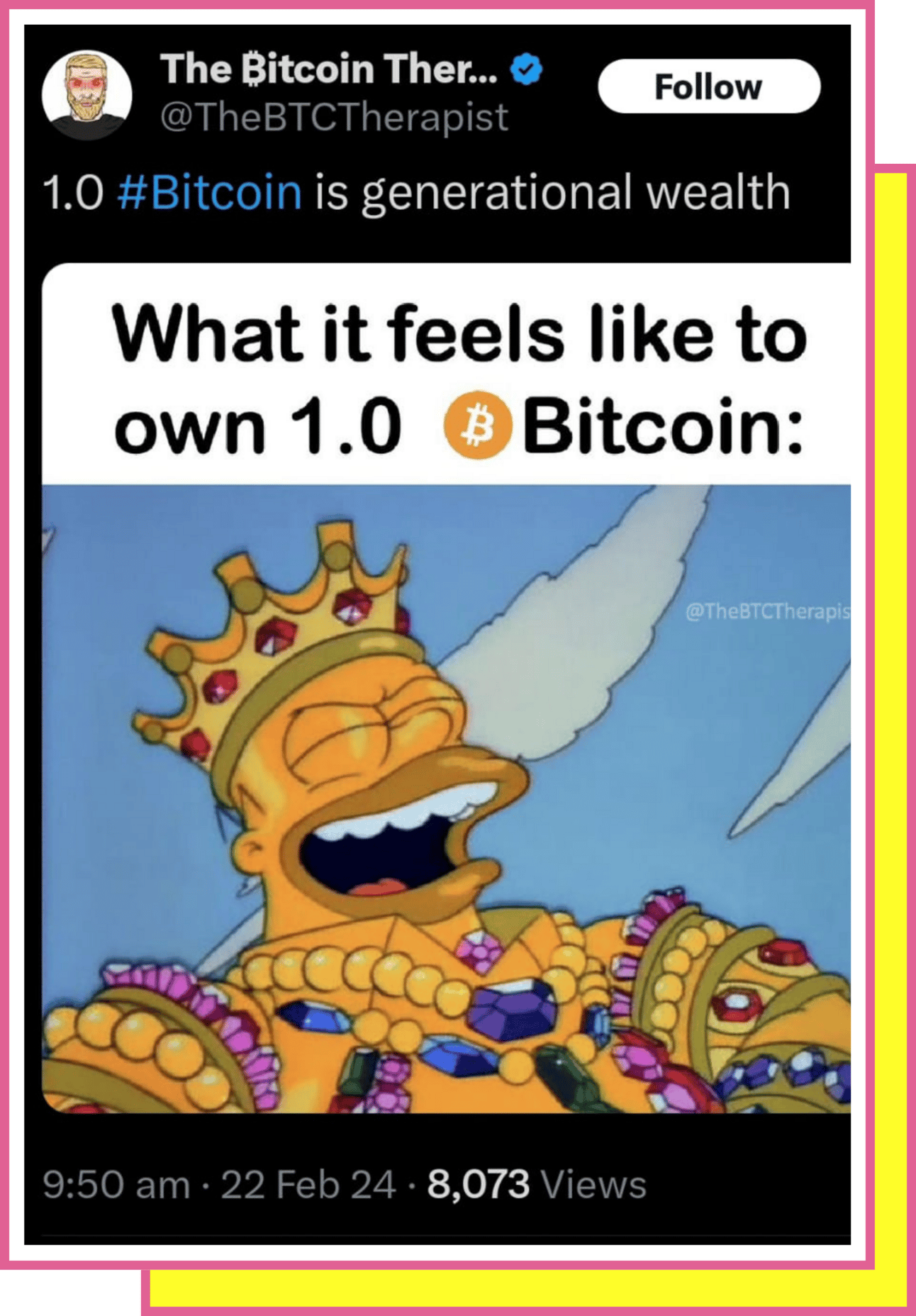
🤣 Crox Road Memes


“The Bitcoin, in its majestic equality, forbids rich and poor alike to sleep under bridges, beg in the streets or steal bread.”

Visit Our Store Here 👉🏻 https://croxroad.store/